
Backwards Curriculum Planning: Worth it or Forget About it?

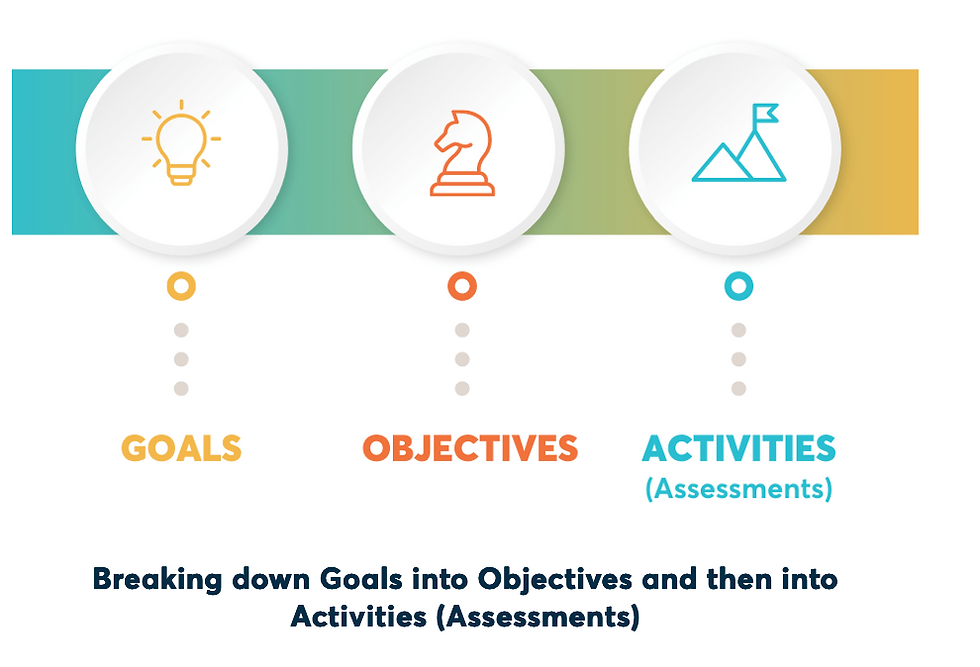
1. Think about the standard of "goal-based design" and the "Design-Down, Deliver-Up" Model we discussed in class, how does such philosophy resonate with curriculum alignment?
2. Imagine now you have total control over curriculum development and are creating a yearly planning guide - how do you plan to align assessments with learning objectives? How often and in what forms do you plan to assess the students?
Curriculum alignment ensures that all components of the curriculum, written, taught, and assessed are aligned to reach the designated or specific goal. “Goal-based design” and the “Design-Down, Deliver-Up” model directly align with the objective of curriculum alignment.
Both” goal-based design” and the “Design-Down, Deliver Up” have a backward design in that the curriculum is designed from the top down. Learning outcomes are first established and designed. Everything else- the learning strategies, assessments and content are built around the designated learning outcomes. In essence, these models are aligning the curriculum as it is being built. Student outcomes improve when curriculum is aligned. By using the standard of “goal-based design” and the “Design-Down, Deliver-Up” Model, students are better equipped to succeed at future academic encounters.
This educator is a fan of efficiency. I guess you could say that it is one of my core values. The “goal-based design” and the “Design-Down, Deliver-Up” model seem to encapsulate the concept of efficiency a alignment occurs during creation. Perhaps this creates less risk of curriculum not being aligned to standards and learning objectives. These models strengthen the integrity of the curriculum to be used to reach designated learning outcomes. One of the interesting benefits of “goal-based design” is that it can assist districts in selecting projects or goals that leadership believe can be accomplished
(Glatthorn et al, 2019).

This educator’s perspective is that there are too many summative assessments that bring little value to the planning process. Most summative assessments at district level take a substantial length of time to aggregate, resulting in untimely feedback. If standardized testing is to be conducted, there needs to be a clear plan of how the data gleaned from the results would be used. I am reminded of Finland schools. They use summative assessments, but they hold very little weight for marks or grades but rather to inform a student’s learning journey. They summative assessment scores are seldom written down. District schools are not compared to each other. This educator brings Finland’s processes up to reiterate that competition between schools within districts does no benefit students, teachers or leadership. Competition does more harm than good.
A needs assessment would be conducted to determine what has worked well in the past regarding curriculum and what is still needed to meet the needs of the children that will be the recipients of curriculum in question. By beginning first with learning objectives or finish lines and second creating assessments to identify mastery of designated learning objectives, curriculum could then be developed that would fully support the learning object.
This educator would align learning objectives with assessments by creating first assessments before developing curriculum. Teachers would work together, when possible, given the autonomy to create assessment that would include specific, required characteristics. Professional development opportunities would be held where teachers could brainstorm and develop tools that would support learning development from year to year including but not limited to assessments.
Assessment specific characteristics would support multiple learning styles. These assessments would consist of mostly formative assessments that would include multiple options such as open-ended questions, surveys, conversations, weekly check-ins and games. The formative assessments would be developmentally appropriate and offering and various times of the year. For example, at a minimum weekly, but as frequently as daily and at the end of a unit. The ideology is that teachers would know as the curriculum was implemented how the students were doing regarding mastery of the material. This would guide teaching strategies and accommodations throughout the learning journey, rather than reaching the end of a unit or term and realizing multiple children were not mastering material.
Pre and post assessments can be valuable in identifying gains made by each student. These assessments should be structured to support multiple learning styles and types. They could even be conducted as informal questions and conversations in one-on-one settings.
Accountability, alignment and further curriculum development can be influenced by various advisory boards. The district advisory council concept is intriguing to this educator. However, this educator is most interested in the local school advisory council concept. This group would be made up of the principal, teacher and parents. The voices of those closest to the curriculum implementation and its impact need to be heard. These voices can help guide curriculum restructuring and improvement.
There would be a need to also implement a form of teacher monitoring to help preserve the integrity of the curriculum. This monitoring concept would be a form of self-evaluation. Each teacher would have designated goals they structured connected to the learning objectives. They would have the responsibility of implementing the assessments they created and reporting the outcome. They also would submit a recording, video or examples of curriculum implementation. These examples would include a hands-on strategy, written strategy and oral strategy, to be sure all learning styles were being supported.

Hello! Thank you for all you do to invest in future generations.